OTIVE @ 63: DECONSTRUCTING THE STATE, RECLAIMING JUSTICE AND THE POLITICS OF FREEDOM
At the 3rd Otivism Lecture, thinkers, activists and friends of Dr. Otive Igbuzor interrogate the Nigerian state, warn against political apathy ahead of 2027, and celebrate a man whose life has become a living argument for integrity in public life.
By Monday Osasah
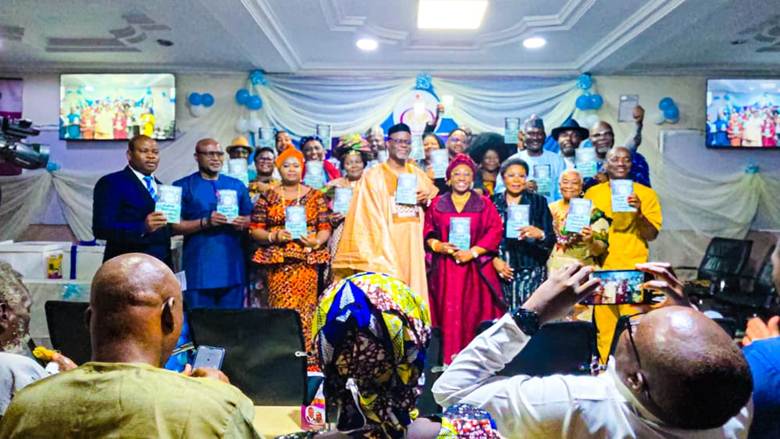
It was pomp, pageantry and eulogy on Sunday, September 6, 2026, as friends, colleagues, activists, politicians, development practitioners and admirers gathered to mark the 63rd birthday of Dr. Otive Igbuzor, founding Executive Director of the African Centre for Leadership, Strategy & Development (Centre LSD).
But this was no ordinary birthday celebration.
At the heart of the gathering was an uncomfortable question: What kind of state does Nigeria have, and what kind of state does Nigeria need?
The question was at the centre of the 3rd Annual Otivism Lecture, an intellectual gathering established to examine and interrogate Igbuzor’s philosophical perspectives, particularly his ideas on the deconstruction and reconstruction of the Nigerian state.
For a man whose life has traversed activism, development work, politics, faith, scholarship, and leadership development, the subject could hardly have been more appropriate.
Otivism is not merely about Otive Igbuzor.
It is a challenge to the assumptions that have shaped the Nigerian state and, ultimately, the lives of its citizens.
Beyond the argument between state and market
The conventional debate about development often presents two competing choices.
The developmentalists argue that government must actively drive development, including through the establishment and management of enterprises. The opposing school insists that the state should keep its hands off the economy and allow market forces to determine outcomes.
Otivism questions the adequacy of this binary.
From this perspective, both positions operate largely within the framework of the capitalist state, a state whose structures and institutions can ultimately be shaped by the interests of capital.
And therein lies the problem.
When the state becomes an instrument for the interests of a privileged few, citizens cease to experience it as a vehicle for collective wellbeing. Instead, it becomes a mechanism through which power is exercised, resources are appropriated, and inequality is reproduced.
In such a society, the relationship between those who govern and those who are governed becomes predatory.
Predators become leaders; citizens become prey.
The consequence is a state that exists physically but fails politically and morally.
Nigeria, in this formulation, risks becoming what has long been described as a mere geographical expression, not because it lacks territory, people or institutions, but because the institutions of the state struggle to command legitimacy, justice and the allegiance of citizens.
The state, in the Otivism analysis, does not fully possess a monopoly of force because of the proliferation of competing centres of power and coercion.
But the argument does not end with the destruction of the state.
Indeed, perhaps its most important distinction is that what must be destroyed is not the state, but deception.
Destroy deception, not the state
Deception breeds corruption.
Corruption breeds nepotism.
Nepotism feeds maladministration.
Maladministration destroys public trust.
And when justice disappears, society begins to resemble the very thing government is supposed to prevent.
The argument finds resonance in St. Augustine’s The City of God: remove justice and what remains is little more than organised criminality.
Justice, in this context, is not an abstract theological concept. It means fairness. It means equity. It means a social and political order in which citizens can reasonably expect institutions to work for them rather than against them.
It also offers a lens through which to understand one of Nigeria’s most visible contemporary phenomena, the Japa syndrome.
Why are millions of Nigerians desperate to leave?
The answer cannot simply be reduced to the attraction of foreign salaries or better infrastructure. For many, migration is an escape from a system in which merit, justice, security, and opportunity appear increasingly uncertain.
When citizens lose faith in their society, they begin to search for societies in which they believe their dignity will be better protected.
That is why the crisis of the Nigerian state is ultimately a crisis of justice.
Pain, pleasure, and the responsibility of government
Every society, the lecture argued, is shaped by two fundamental conditions: pain and pleasure.
Where there is pain, government has a responsibility to assuage it.
Government exists not merely to regulate citizens or occupy public buildings. It exists to respond to the conditions of human beings.
This requires structural reform of the state.
Political power, according to the Otivism argument, has become excessively rewarded, while public office has increasingly lost its service orientation.
The result is a political class whose privileges can become disconnected from the lived realities of ordinary citizens.
The challenge, therefore, is not simply to change political officeholders.
It is to change the architecture and culture of governance.
Public office must return to its original meaning: an opportunity to serve.

The 2027 warning
With Nigeria moving steadily towards the 2027 general elections, the Otivism Lecture also became a warning against political apathy.
Citizens cannot afford to stand at a distance from politics and complain about its consequences.
The message was direct:
Get your Permanent Voter’s Card. Participate. Engage. Vote.
Democracy cannot survive on the assumption that politics belongs to politicians.
If citizens retreat, the space will not remain empty. It will be occupied by those who understand politics primarily as an avenue for acquiring power and privilege.
The message was therefore not merely a birthday exhortation.
It was a civic call.
If citizens do not rise, Nigeria will not progress.
The man behind the philosophy
Yet, perhaps the most powerful dimension of the day was not the intellectual interrogation of the state, but the testimony of those who have walked with Igbuzor.
One after another, friends and colleagues painted a portrait of a man whose philosophy is inseparable from his life.
Ezenwa Nwagwu described him as a many-sided man, someone who speaks truth to power like the biblical prophet Micah. He prayed for the celebrant, invoking Psalm 20, a fitting spiritual benediction for a life dedicated to public engagement.
Koripamo Agary brought humour and affection to his tribute.
“Otive, you are 63! If I hadn’t gone to school, you’d have been my son,” he joked.
But beneath the humour was deep admiration.
Agary recalled meeting Igbuzor at the Centre for Democracy & Development (CDD) and later at ActionAid, describing him as someone who has remained remarkably consistent over the years.
For Agary, that consistency is perhaps one of Igbuzor’s most enduring qualities.
A friend for all seasons
Erelu Bisi Fayemi described Igbuzor as a remarkable combination of identities, a pharmacist, pastor and Marxist, all deposited in one person.
But beyond the labels, she spoke of dependability.
Politics, she observed, can be a lonely business. Friends often disappear when political office disappears.
But Igbuzor has remained.
“He is a friend for all seasons,” she said, recalling how he stood firmly with her family.
She also highlighted his commitment as a feminist ally, noting that whenever she encounters a man speaking disparagingly about women, she is quick to direct the matter to Igbuzor.
It was another way of describing the consistency that runs through his life: he does not merely preach values; he inhabits them.
Integrity after power
Andrew Mamedu traced his relationship with Igbuzor back to 2006.
He recalled being recruited by Igbuzor and receiving his guidance before assuming his present role as country director. He also persuaded him to join the board of ActionAid, where they worked together to affect lives.
Mamedu recalled Igbuzor’s role in the formation of the Movement for the Transformation of Nigeria (MOTION), which now boasts more than 30,000 members.
But his most significant tribute concerned integrity.
In a country where public office can leave a permanent stain on reputations, Mamedu pointed to Igbuzor as an exception.
He had worked with a former Deputy Senate President, yet his integrity remained intact.
He entered government without allowing government to redefine him.
That may be one of the strongest tests of the philosophy he has spent decades teaching.
“Otive is my brother”
Then came Regina Omo Agege, whose tribute was perhaps the most intimate.
“Otive is my brother,” she declared.
She spoke of a man who discusses the Bible, a man whose presence itself has become a source of encouragement.
“Otive is one reason to be around,” she said simply.
It was a reminder that the legacy of a public intellectual is not measured only in books, institutions, or policies.
It is also measured in the lives touched along the way.
Integrity in an age of shrinking intellectual space
Rafsanjani placed Igbuzor’s life within the larger crisis facing Nigeria.
He lamented the collapse of intellectualism in a country where people can kill others because of politics.
Yet, even amid the shrinking funding space and the difficult environment for civil society, he noted that Igbuzor continues to shine.
The challenge, he suggested, is for Nigerians to engage more deeply with the ideas contained in the Otivism Lecture and use them to redeem the country.
Ene Obi described Igbuzor as a younger brother and a man who has demonstrated what leadership means.
“Challenge him on any issue but be prepared for a debate,” she said.
It was a tribute to a man who does not run away from ideas or disagreement.
Obi also described him as a proud ActionAider who lives his life the way he preaches it.
That sentence may well capture the essence of the day.
From pulpit to politics
Wakson Jack congratulated Igbuzor on his 63rd birthday and reflected on the significance of his book and ideas.
She noted that Igbuzor had taken his calling beyond the pulpit into politics and public life.
Her observation also carried a warning for Nigeria.
Nigerians do not lack ideas.
What they lack, too often, is the ability to translate ideas into action capable of transforming society.
That gap between knowledge and action remains one of Nigeria’s most enduring development challenges.
And perhaps that is why Igbuzor’s work matters.
He has spent decades attempting to bridge the gap.
A radical sermon for an imperfect society
The intellectual dimension of the celebration was reinforced by the presentation of Igbuzor’s book, Radical Sermons and Liberation Theology, by Professor Sam Amadi.
Amadi described the author as intelligent and hardworking, noting that some books are tested, chewed and swallowed.
Igbuzor’s book, he suggested, possesses a language that is both authentic and accessible. In an age dominated by social media and shrinking attention spans, the book remains readable and attractive.
The 107-page, 13-chapter work is deeply theological, but its implications extend beyond theology.
At its heart is the proposition that the gospel of Jesus Christ remains relevant to every dimension of human life.
Amadi challenged the assumption that poverty is simply a consequence of what government does or fails to do.
He also questioned the tendency among some Christians to confine Scripture to the spiritual realm while ignoring its implications for governance.
Governance, he argued through his presentation of Igbuzor’s work, must also be concerned with righteousness, compassion and holiness.
In other words, faith cannot be separated from public ethics.
The birthday that became a national conversation
And so, what began as a celebration of a 63rd birthday became something much larger.
It became an interrogation of the Nigerian state.
A conversation about justice.
A warning against political apathy.
A challenge to the abuse of public power.
A defence of intellectual engagement.
And a celebration of integrity.
Perhaps that is the most fitting tribute to Otive Igbuzor.
At 63, his most enduring contribution may not be a particular office he has occupied or a particular institution he has built. It may be the body of ideas and values he continues to place before a country searching for direction.
Nigeria does not merely need new leaders.
It needs a new relationship between citizens and power.
It needs public officials who understand office as service.
It needs citizens who refuse to surrender politics to predators.
It needs institutions anchored in justice rather than deception.
And it needs intellectuals who will continue to speak truth to power—even when power would rather not listen.
That is the deeper meaning of Otivism.
It is not a celebration of one man.
It is a challenge to a nation.
At 63, Otive Igbuzor is still asking Nigeria to confront itself.
Osasah wrote from #3B, Niger Avenue, Apo, Abuja