NIGERIA DOESN’T NEED MORE LEADERS, IT NEEDS BETTER LEADERSHIP
By Monday Osasah
Nigeria has never lacked leaders. We have presidents, governors, legislators, ministers, permanent secretaries, directors-general, commissioners, traditional rulers, business executives, academics and community leaders. We have no shortage of people occupying positions of authority.
Yet the country continues to struggle with poverty, insecurity, unemployment, institutional decay, corruption and a widening crisis of public trust. The uncomfortable question, therefore, is not whether Nigeria has leaders. It is what kind of leadership Nigeria has produced, and what kind of leadership Nigeria needs to survive and prosper.
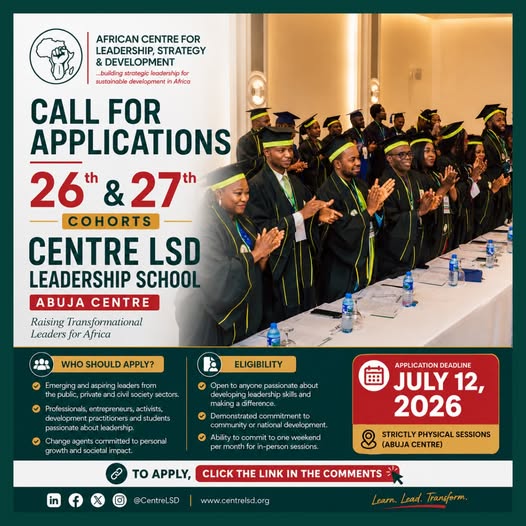
That question provided the underlying theme of the Centre LSD Leadership School graduation ceremony held on September 5, 2026.
For the graduating leaders, the ceremony was not just about receiving certificates. It was a challenge to move from learning to action, from observation to participation and, most importantly, from lamentation to solution.
Chief Ezenwa Nwagu put it bluntly: “Solution activism is what the Leadership School is about: identify problems, solve them, and not lament over them.”
There could hardly be a more appropriate message for Nigeria.
But the most compelling evidence that this philosophy is taking root did not come only from the speakers. It came from the graduates themselves.

Their testimonies tell a story of people who entered the school with questions, limitations, uncertainty, and, in some cases, deeply ingrained habits, and emerged with a different understanding of leadership.
They came to learn leadership.
Many discovered that they first had to learn how to lead themselves.
They came looking for knowledge.
They left with a responsibility to apply it.
And, in several cases, the classroom lessons have already translated into measurable changes in workplaces, businesses and communities.
A Country Addicted to Lamentation
Nigeria has become remarkably good at identifying its problems. We know what is wrong with our politics. We know that our elections are deeply flawed. We know that many public institutions are failing. We know that corruption is damaging development. We know that young people are struggling to find decent opportunities.
We discuss these problems endlessly.
We write reports. We organise conferences. We issue statements. We conduct workshops. We hold town hall meetings.
But the distance between knowing what is wrong and doing something about it remains one of Nigeria’s greatest development challenges.
This is why the idea of solution activism is important.
It demands a different mindset, one that sees leadership not as an opportunity to occupy space but as a responsibility to create change.
The Chairperson, Hauwa Mustapha, reinforced this message by placing trust, courage, and purpose at the centre of leadership.
“The trust of those you lead is the proof of your leadership. Lead with courage, speak for what is right, and lead with purpose by asking: who benefits from my leadership? Influence is not measured by how many people know your name, but by how you impact humanity.”
That may be one of the most important questions Nigeria’s leaders can ask themselves:
Who benefits from my leadership?
Not: How much power do I have?
Not: How many people know me?
Not: What position do I occupy?
But: Who is better off because I lead?
The graduates’ testimonies suggest that this is precisely the kind of question the Leadership School is teaching them to ask.
For Ijeoma Juliet Igwe, Centre LSD fundamentally changed her understanding of leadership. Before the programme, she largely associated leadership with position, authority, and being in charge. She emerged with a different philosophy: “I can lead from where I am.”
That change in mindset was not merely theoretical.
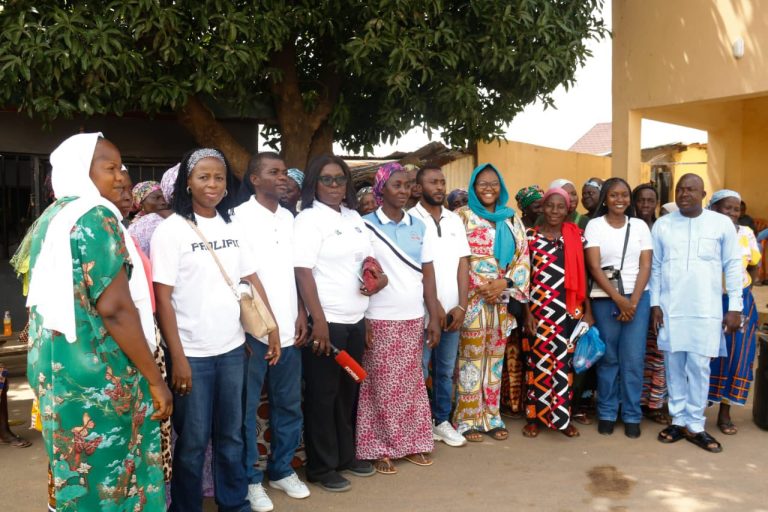
Her CDS group intervened at the Durumi II Police Outpost, where they identified infrastructural challenges, including damaged roofing and ceilings, and the generally poor condition of the environment. They worked collectively to contribute to its renovation and improvement.
The lesson was profound: meaningful leadership does not always require enormous resources or an influential position.
It requires responsibility.
Centre LSD, she says, changed the question from “Who is in charge?” to “Who is willing to take responsibility?”
The Crisis of Trust
Dr. Boma Onwuka Saint-Paul of the Ministry of Education identified three values that must guide responsible leadership: integrity, accountability, and trust.
Her message speaks directly to Nigeria’s leadership crisis.
Leadership without integrity is dangerous because power becomes detached from values. Leadership without accountability is even more dangerous because it creates an environment where those who exercise power are not required to explain their decisions.
And when integrity and accountability disappear, trust collapses.
Once citizens stop trusting institutions and leaders, governance becomes increasingly difficult.
This is why rebuilding public trust cannot be treated as a public-relations exercise. It requires a fundamental transformation in how leadership is understood and practised.
That transformation begins with character.
One graduate, Patience Ikoro Akwa, speaks of discovering this dimension of leadership during her time at the school. She entered the programme wondering whether, as a Gen Z participant, she was too young to be in the room or had enough experience to contribute meaningfully.
The school challenged those limitations.
She discovered that she was neither too young nor too inexperienced to learn, lead and make an impact. The experience produced what she describes as a complete mindset shift.
She learned financial discipline, teamwork, self-leadership and responsibility. She also discovered hidden talents and untapped potential and found the courage to turn those gifts into opportunities.
One of the clearest manifestations of that growth, she says, is that she has started several businesses that are now thriving.
Her testimony reinforces a fundamental truth: leadership is not defined by age, title, or position. It is defined by the lives we influence, the values we uphold, and the legacy we leave behind.
Leadership Is About Consequences
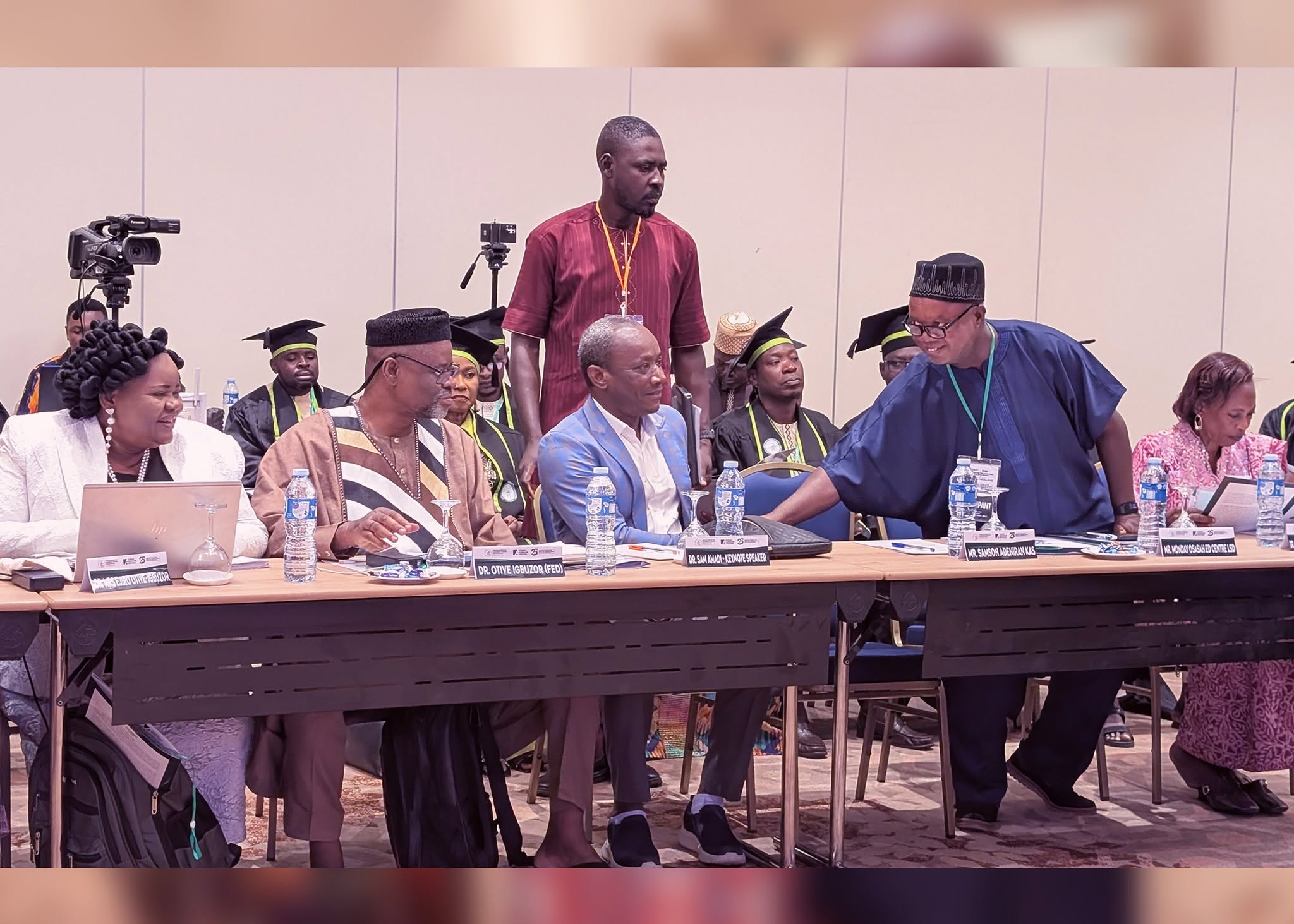
Delivering the keynote lecture, “Leadership, Election and Development,” Dr. Sam Amadi took the discussion to another level.
His argument was that leadership matters because leadership decisions have consequences. He described Centre LSD Leadership School as a “laboratory of leadership,” acknowledging the vision of its founder, Dr. Otive Igbuzor.
For Amadi, leadership is not simply a fashionable word that has become a cliché. It is fundamental to the organisation and progress of society.
He illustrated this through the biblical story of Adam, arguing that leadership comes with responsibility and that responsibility carries consequences.
The point is particularly relevant in Nigeria, where accountability often seems to stop at the point where political power begins.
If leadership decisions produce consequences for citizens, then leaders must also be prepared to bear responsibility for those consequences.
The graduates are beginning to understand that principle in practical terms.
For Amb. Salihu Honest Gode, the Leadership School provided the bridge between passion and purposeful action. He entered with a strong interest in community development and youth leadership but wanted to become a more strategic, confident, and effective leader.
He soon found himself applying those lessons.
As Group Leader of Set 24, Group 7, he coordinated the Girl-Child Menstrual Health Outreach at Government Secondary School, Lugbe, Abuja. The project reached 190 female students, providing menstrual health and hygiene education, confidence-building discussions, and practical guidance on sanitary pad use and sanitary pads.
More important than the project itself was what it taught him about leadership.
He now approaches community initiatives with greater structure, clearer objectives, stronger stakeholder engagement and a greater focus on measurable outcomes.
His conclusion captures the philosophy of the school: leadership is not merely about holding a position; it is about using one’s capacity to create opportunities, solve problems, and improve people’s lives.
Institutions Do Not Operate in a Vacuum
One of Amadi’s most compelling arguments was his examination of the relationship between leadership and institutions.
Institutions matter.
But institutions do not operate independently of the people who lead them.
Leadership determines institutional culture. Leadership establishes incentives. Leadership defines standards. Leadership determines whether rules are respected or ignored.
Amadi illustrated this with a provocative question: Why does the Nigerian Police often perform effectively when its officers operate abroad but behave differently at home?
The answer, he suggested, lies in context, leadership, and institutions.
The lesson is uncomfortable but important.
Perhaps Nigerians are not inherently incapable of excellence. Perhaps our institutional environments often determine whether excellence is rewarded or punished.
Perhaps the challenge is not simply the quality of the Nigerian but the quality of the systems within which Nigerians are expected to operate.
This is why leadership matters.
Good leadership can build functional institutions.
Bad leadership can destroy even institutions with excellent laws, structures and personnel.
One of the graduates, Francisca Ogar, offers a striking workplace example.
She joined Centre LSD at almost the same time she was assuming a leadership position in a new organisation. Having spent 14 years in her previous organisation, she recognised that she might have become accustomed to a particular leadership style and needed fresh insight, learning and relearning.
That decision became, in her words, her “saving grace.”
Her new organisation was initially marked by resistance. People who were accustomed to established ways of doing things viewed suggestions and innovation with suspicion.
But rather than responding to resistance with force, she applied the leadership principles and methods learned at Centre LSD.
The result was remarkable.
She moved from surviving organisational turbulence to winning over even those whose resistance was strongest. Today, she reports a high level of cooperation, with people working together as a team.
This is leadership education producing an institutional outcome: resistance giving way to cooperation.
The Military and the Erosion of Merit
Amadi also pointed to the impact of military intervention on Nigeria’s civil service, particularly the erosion of merit.
The lesson extends beyond history.
Institutions are built over time but can be weakened rapidly by poor leadership choices.
Once merit is sacrificed for patronage, competence gives way to loyalty. Once loyalty becomes more important than performance, institutions begin to decline.
And when institutions decline, development suffers.
The Leadership School’s emphasis on integrity, accountability, competence, and strategic thinking therefore speaks to a challenge much larger than individual career advancement.
It is ultimately about rebuilding the human and institutional infrastructure required for national development.
From Being Busy to Becoming Strategic
Perhaps the most powerful testimony from the graduating class comes from Ini Eshiet Rejoice Chinyere.
Her story captures the difference between activity and leadership.
Before Centre LSD, she describes herself as “busy but not effective.”
She measured success by how tired she was.
If there was a problem, she solved it.
If there was an event, she ran it.
If something was not done, it was because she had not done it.
She had passion. She had energy.
But she had no vision, no system, and no succession plan.
Everything depended on her.
And because everything depended on her, her impact was limited by her personal capacity.
Centre LSD changed that.
The most important lesson she took away was that leadership is not about doing more. Leadership is about building people and systems that can work without you.
That insight moved her from an “operator mindset” to a “strategic leader mindset.”
She began putting vision before action, asking what the three-year picture was and what system she was building before beginning a project, business, or community initiative.
Then came the harder part: developing other leaders.
She selected five young people in her church and trained them using principles from the Leadership School. They subsequently helped deliver a Purpose and Strategy Bootcamp that trained 34 youths. Three months later, 22 of them had started their own projects in agribusiness, skills development and school leadership.
The impact had begun to multiply beyond her.
The transformation was equally evident in her business.
She introduced quarterly planning, tracking, and quality control. A business that was moving about 400 crates of eggs weekly in January was seeking to scale to 3,000 crates weekly by August 2026 to meet demand.
Her pastor noticed the difference.
Previously, when she travelled, the work stopped. Now, young people were running it in her absence.
That, perhaps more than any certificate, was evidence of leadership.
Her testimony is simple: Centre LSD helped her move from being a hard worker to becoming a strategic leader who builds other leaders.
What Makes a Good Leader?
So, what kind of leaders does Nigeria need?
For Amadi, good leadership begins with the ability to mobilise people to work.
A leader cannot transform society alone. Leadership is about bringing people together around a common purpose.
Good leaders must also help people learn from experience and understand that progress sometimes involves sacrifice.
They must be visionary.
But vision alone is insufficient.
A leader must have a coherent course of action, a strategy for translating vision into results.
This is where human resources become critical.
Leadership is ultimately about people. The best strategy will fail if leaders cannot inspire, organise and develop the people required to implement it.
And none of this can happen without communication.
Leadership and communication are inseparable.
A leader who cannot communicate cannot mobilise.
A leader who cannot listen cannot understand.
And a leader who cannot create a culture of accountability cannot build a sustainable institution.
The experience of Ruth Chidera Echewe illustrates this transition from leadership as position to leadership as responsibility.
She describes the Leadership School as a year of intentional growth, self-discovery, renewed purpose, and practical impact. The programme exposed her to transformative leadership, ethics, emotional intelligence, personal branding, civic responsibility, community organising, financial intelligence, communication and problem-solving.
But the deeper transformation was conceptual.
She learned to stop seeing societal challenges merely as problems to complain about and begin seeing them as opportunities to create solutions.
She has since applied those lessons in mentoring young people, facilitating conversations, coordinating programmes and promoting civic participation, youth engagement, gender inclusion and social responsibility.
Her greatest takeaway is perhaps one of the most profound definitions of leadership to emerge from the testimonies:
Leadership is not about how many people follow you, but how many lives become better because you chose to lead.
The Election Question
Perhaps the most politically significant part of Amadi’s lecture was his treatment of elections.
Elections are not merely about choosing political office holders. They are a mechanism for resolving political conflict peacefully and establishing legitimacy.
And legitimacy matters for development.
Where citizens believe that their votes count, leaders have stronger incentives to listen to them. Where elections are manipulated, those incentives disappear.
Amadi therefore identified bad elections as one of the biggest enemies of development, arguing that Nigeria’s electoral system must create incentives for political leaders to respond to citizens.
This is why electoral reform cannot be separated from the leadership question.
A country cannot consistently produce accountable leaders through an electoral system that rewards impunity.
The challenge is therefore not simply to produce better candidates.
It is to build a political system that rewards good leadership and punishes bad leadership.
Leadership Education as a Democratic Investment
This is where the Centre LSD Leadership School occupies an important space.
Leadership education cannot replace electoral reform, institutional reform or political accountability.
But it can complement them.
By developing leaders who understand strategy, integrity, accountability, communication and public service, leadership schools can help create the human capital required to drive institutional transformation.
The Leadership School’s task, therefore, goes beyond producing graduates.
It is about producing people capable of influencing institutions and communities positively.
Okoh Oluchi Nwamaka’s testimony illustrates this professional dimension.
She describes Centre LSD as providing rigorous training in leadership, strategic thinking, and organisational development within an African context. Through practical coursework, mentorship, and applied strategy sessions, she developed competencies in decision-making, team leadership, stakeholder engagement, and development planning.
A community development project at LEA Primary School, Wuse Zone 3, allowed her to apply leadership principles to a real development problem and reinforced her understanding that true leadership is about service.
Since her participation, she has assumed increased leadership responsibilities as Vice President of WealthBridge Asset Management Ltd., where she says she has applied the strategic frameworks learned at Centre LSD to deliver measurable outcomes.
Her assessment is unequivocal: the programme had a transformative impact and equipped her to contribute more effectively to institutional and community development.
The Danger of Certificates Without Values
Dr. Chukwuemeka Okereafor reminded the graduands that the ceremony should not be seen merely as a celebration of academic achievement. It should be a celebration of the knowledge, skills, and values acquired to solve society’s problems.
This is a crucial distinction.
Nigeria has millions of educated people.
But education without values can produce highly intelligent people who are equally capable of exploiting public institutions.
Certificates do not automatically produce leaders.
Degrees do not automatically produce integrity.
Knowledge does not automatically produce courage.
Leadership requires something more.
It requires values translated into action.
Okereafor captured the urgency of the moment when he declared:
“I’m tired of lamenting over the issues.”
That statement could well become the motto of a new generation.
Nigeria has heard enough lamentation.
The country needs people who will roll up their sleeves and work.
Maryam Muhammad Garba’s testimony demonstrates what that transition can look like.
She entered Centre LSD passionate about education and community development. She had ideas and a desire to create opportunities for young people but needed the confidence, skills and direction to turn those ideas into action.
The school helped provide that transformation.
Through her work with the Ummah Literacy Project, she has applied the lessons of leadership, collaboration, responsibility and empowerment to support more than 130 students through educational and Qur’anic literacy activities.
Her own description of the journey is a fitting summary:
She came with passion and ideas; she is leaving with the courage, skills and purpose to turn them into impact.
The Real Graduation Begins Now
The irony of a leadership graduation ceremony is that the most important part begins after the ceremony.
The certificate is evidence of what has been learnt.
The real examination is what happens next.
When the graduate encounters corruption, will he or she resist it?
When confronted with injustice, will the graduate remain silent?
When given authority, will the graduate abuse it?
When faced with difficult choices, will integrity survive?
When people lose hope, will the graduate provide leadership?
When a problem emerges, will the response be another complaint, or a solution?
These are the questions that will determine whether the Centre LSD Leadership School has produced graduates or leaders.
The testimonies suggest that many of the graduates have already begun answering those questions.
One discovered that she could overcome resistance and build teamwork.
Another reached 190 schoolgirls through a practical community intervention.
Another discovered her potential and turned it into thriving businesses.
Another moved into greater professional leadership.
Another trained young people who have gone on to start their own projects.
Another helped improve a neglected police outpost.
Another supported more than 130 students through literacy initiatives.
Another learned that she did not need a title before she could lead.
These are not abstract leadership lessons.
They are leadership in action.
A New Leadership Contract
The speeches at the graduation ceremony collectively suggest the need for a new leadership contract in Nigeria.
A contract based on trust rather than fear.
Service rather than self-enrichment.
Accountability rather than impunity.
Purpose rather than personal ambition.
Solutions rather than excuses.
For Nigeria to develop, its citizens must demand this kind of leadership.
But citizens must also recognise that leadership is not something that exists only in Abuja or inside government houses.
Leadership happens everywhere.
In schools.
In communities.
In businesses.
In civil society.
In universities.
In the media.
In professional associations.
And in ordinary families.
Every person who influences another person exercises some form of leadership.
The question is what that influence is being used for.
The testimonies of the graduates offer a powerful answer.
Leadership is being understood less as the privilege to command and more as the responsibility to serve.
Less as personal achievement and more as collective progress.
Less as doing everything oneself and more as building people and systems.
Less as lamenting problems and more as solving them.
The Leadership Nigeria Deserves
Amadi’s final message was both simple and profound: for a country to become great, it must have great companies and great universities.
But behind great institutions are people.
And behind great people is leadership.
When leadership fails, there are consequences.
When leadership succeeds, there are also consequences.
The difference is that one produces stagnation while the other creates possibilities.
The new graduates of the Centre LSD Leadership School therefore leave the classroom with more than certificates.
They leave with a responsibility.
A responsibility to challenge the culture of lamentation.
A responsibility to rebuild trust.
A responsibility to defend integrity.
A responsibility to demand accountability.
A responsibility to mobilise people.
A responsibility to solve problems.
And above all, a responsibility to lead with purpose.
The most telling lesson from their testimonies is that transformation does not necessarily begin with occupying a powerful office.
It can begin with leading a team through resistance.
With asking a difficult question.
With repairing a police outpost.
With educating a girl about menstrual health.
With supporting a child to read.
With training five young people who then train others.
With building a business that can survive when its founder is absent.
With finding the courage to discover one’s own niche.
In that sense, the Leadership School is making a larger argument about Nigeria.
The country does not lack people with ideas.
It does not lack educated people.
It does not even lack people willing to complain about what is wrong.
What it lacks is enough people willing to take responsibility for making things right.
Nigeria does not need more people merely occupying leadership positions.
Nigeria needs people who understand that leadership is service, that power carries responsibility, that decisions have consequences, that institutions reflect the values of those who lead them, and that the true measure of influence is not how many people know your name but how many lives are transformed by your leadership.
The graduation may have ended on September 5.
But for the graduands, the real leadership examination has just begun.
Osasah wrote from #3B, Niger Avenue, Apo, Abuja.